Product IntroductionDefinition of Flexible Socket Joint
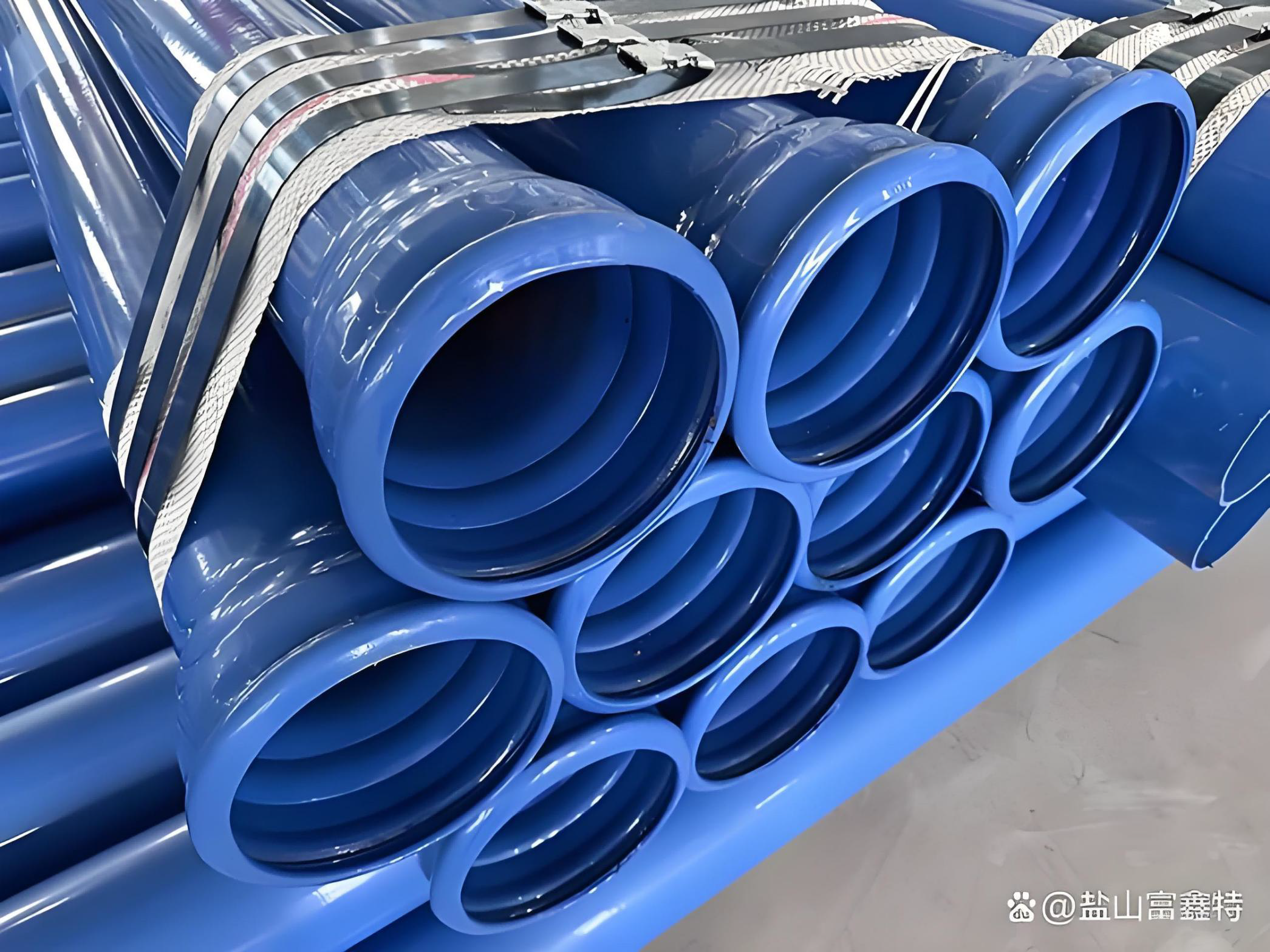
• A flexible socket joint refers to a pipe connection where a rubber sealing ring is placed on the stop seal of the pipe socket, and then force is applied to insert the pipe end, forming a closed pipe connection that can adapt to water pressure and displacement within a certain range. This joint is an advanced pipe connection technology that eliminates pipeline stress and longitudinal stress caused by uneven foundation settlement.
• Features: The pipe-to-pipe connection is sealed with a sealing ring, and a certain degree of axial displacement and radial deflection can be achieved.
Pipes using socket joints: Ductile iron pipes, PCCP pipes, PVC pipes, fiberglass pipes, steel pipes...
Scope of Application• Socket-joint flexible steel pipes have a wide range of applications, including building water supply, municipal water supply, fire-fighting water supply, water conservancy projects, irrigation water, reclaimed water, sewage, long-distance water transmission, petroleum, chemical, natural gas, heating, and refrigeration.
1. Municipal Water Supply and Drainage Engineering: Used for connecting urban water supply and drainage pipelines, adapting to pipeline displacement caused by ground settlement and temperature changes.
2. Fire Protection Pipeline Systems: Ensures the sealing reliability of fire protection pipelines in emergency situations, while adapting to building structural deformation.
3. Petrochemical Industry: Pipelines transporting various liquid media, especially under conditions of vibration and small displacement.
4. Industrial Plant Pipelines: Such as water supply, gas supply, and chemical transportation pipelines in factories.
5. Ground Source Heat Pump Systems: Adapts to pipeline deformation caused by changes in geological conditions and temperature differences during system operation.
6. Sewage Treatment Plants: Connection of sewage transportation pipelines, coping with complex environments and pipeline displacement.
Product Advantages1.High molding precision
2.High cost-effectiveness
3.Fast installation speed
4.Low head loss
5.Long service life
6.Large permissible angle
7.Seismic and settlement resistant
8.Lightweight pipes
9.High compressive strength
10.Complete range of pipe fittings
| No. |
Performance Index |
Prestressed Concrete Cylinder Pipe (PCCP) |
Steel Pipe (SP) |
Ductile Iron Pipe (DIP) |
FRP Pipe (FSP) |
|
Joint Type |
Flexible socket & spigot joint |
Welded joint |
Flexible socket & spigot joint |
Flexible socket & spigot joint |
| 1 |
Joint Characteristics |
Moderate deformation adaptability; prone to misalignment, damage and leakage under external force |
Good integrity, rigid pipeline |
Strong deformation adaptability; still prone to misalignment, damage and leakage under force |
Strong deformation adaptability |
| 2 |
Weight |
Heavy; difficult for transportation and lifting |
Moderate |
Relatively heavy; labor-intensive transport and installation |
Lightweight |
| 3 |
Safety |
Moderate |
Strong resistance to hydraulic hammer; not prone to bursting; high safety |
Strong resistance to hydraulic hammer; not prone to bursting; relatively high safety |
Strong resistance to hydraulic hammer; not prone to bursting; high safety |
| 4 |
Applicable Diameter |
600–4000 mm |
No limitation |
300–800 mm |
50–3600 mm |
| 5 |
Terrain Adaptability |
Moderate |
Strong |
Relatively strong |
Relatively strong |
| 6 |
Internal Pressure Resistance |
Moderate |
Strong |
Strong |
Strong |
| 8 |
Environmental Performance |
Good, no pollution |
Good, no pollution |
Good, with pollution |
Good, no pollution |
| 9 |
Corrosion Resistance |
Moderate |
Moderate |
Strong |
Strong |
| 10 |
Length |
6 m |
6 m |
6 m |
12 m |
| No. |
Performance Index |
Prestressed Concrete Cylinder Pipe (PCCP) |
Steel Pipe (SP) |
Ductile Iron Pipe (DIP) |
FRP Pipe (FSP) |
|
Joint Type |
Flexible socket & spigot joint |
Welded joint |
Flexible socket & spigot joint |
Flexible socket & spigot joint |
| 11 |
Service Life |
30–60 years |
< 30 years |
> 50 years |
> 50 years |
| 12 |
Sealing Performance |
Small rubber ring diameter, prone to leakage |
Fully welded, no leakage |
Relatively good |
Relatively good |
| 13 |
Flexibility |
Small deflection |
Large deflection |
Large deflection |
Large deflection |
| 14 |
Installation |
Moderate |
Moderate |
Convenient |
Convenient |
| 15 |
Roughness Coefficient (n) |
0.013 |
0.012 |
0.012 |
0.0086 |
| 16 |
Processing Difficulty |
Easy |
Easy |
Easy |
Easy |
| 17 |
Foundation Requirements |
High requirements for bedding and backfill |
No special requirements for bedding and backfill |
No special requirements for bedding and backfill |
No special requirements for bedding and backfill |
| 18 |
Construction Requirements |
Heavy pipe weight, difficult hoisting, large earthwork excavation |
Mature construction technology |
Mature construction technology |
Mature construction technology |
| 19 |
Construction Difficulties |
Avoid collision |
Internal & external anti-corrosion |
Bedding compaction |
Foundation treatment |
| 20 |
Key Advantages |
Good external pressure resistance |
Strong adaptability |
Corrosion resistance, fast construction |
Long service life, smooth inner wall, corrosion resistance, fast construction |
| 21 |
Cost Performance |
Good |
Good |
Excellent |
Excellent, high cost-performance with environmental benefits |
• Flexible and quick installation: Taking 1620 pipe as an example, two joints can be installed per hour, significantly reducing project costs.
• Welding has low construction efficiency and is prone to quality defects, increasing the probability of pipe bursts.
• Does not damage the anti-corrosion coating; pipe ends do not require secondary repairs, ensuring the corrosion resistance of the joint.
• Flexible joints allow for deflection at a certain angle, enabling laying according to the curvature of the pipeline. They also prevent pipe bursts caused by geological subsidence, reducing leakage rates.
• In water supply and drainage engineering, flexible joints offer good economic benefits and significantly improve the operational quality and safety of water transmission networks.
Comparison of Flexible Socket Steel Pipes and Ductile Iron Pipes• Ductile iron pipes have disadvantages such as thicker walls and poorer toughness; the larger the diameter, the higher the price.
• Ductile iron pipes are lined with cement mortar, which is relatively rough, resulting in greater head loss and relatively poor long-term economic efficiency of the pipeline network.
• The standard length of a ductile iron pipe is 6m, while that of a steel pipe is 12m. The doubled number of joints increases the cost of rubber rings and also increases the leakage rate.
Ø The preferred coating for flexible socket steel pipes is black polyethylene to reduce wear on the pipe surface.
Common interface methods
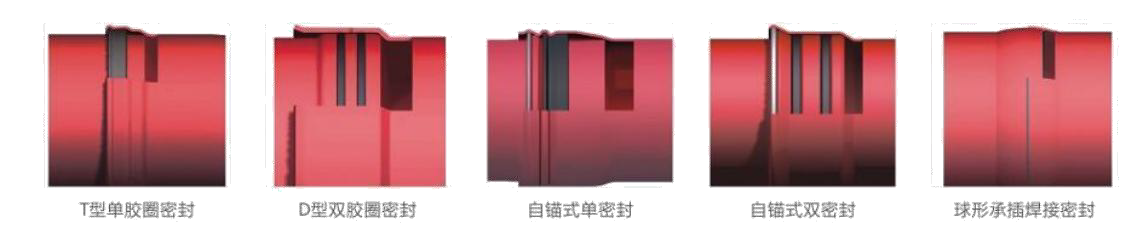
Currently, the two most widely used types are single rubber rings and double rubber rings, with double rubber rings being the most common in the Xinjiang region.
T-type single rubber ring
Ø The rubber ring is positioned into the sealing area through the socket. The spigot slides into the socket with axial force, while the rubber ring is compressed. When subjected to pipeline pressure, the more the rubber ring displaces to the outer end, the greater the compression ratio, achieving axial self-tightening and radial sealing.
Standard comparison
Standard Comparison:
Rubber Ring:
The 10159 standard rubber ring is the same as the ductile iron rubber ring and is interchangeable, reducing differences and lowering costs.
Pipe Diameter Difference:
All sizes of spigots conforming to the 10159 standard only require inward taper, while spigots conforming to the 108 standard (DN600 and above) require outward expansion, increasing production costs.
Construction:
For DN600 and above joints conforming to the 108 standard, welding is required at bends; for 10159 standard joints, the spigot end only needs to be beveled or directly inserted.
Processing of socket steel pipes - Corrosion protection methods
External wall corrosion protection: mainly epoxy powder and polyethylene powder, with a few projects using 3PE.
Internal wall corrosion protection: mainly epoxy powder, with a few using 8710.
For socket steel pipes, a design different from the traditional one is adopted for the transmission of 3PE-coated steel pipes and the rotation of plastic-coated steel pipes.
Construction of socket steel pipes - technical characteristics
Formed welding, flexible joints, and internal and external corrosion protection are the three key technologies determining the quality of socket-jointed flexible joint steel pipes. Flexible T-joint steel pipes can achieve the same performance requirements as domestic ductile iron water pipelines. In particular, the reduced wall height design of the steel pipe reduces investment, resulting in a significant cost advantage compared to ductile iron pipes, offering high cost-effectiveness.
Socket-jointed flexible joint steel pipes feature high forming precision and are interchangeable with ductile iron pipes; they are installed quickly, 4-6 times faster than other pipes; they can increase transport capacity by approximately 30%; they have a long service life, eliminating the need for on-site joint corrosion protection, reducing corrosion, and preventing secondary pollution; they have good seismic and anti-settlement performance, with the flexible joint reducing the damaging effects of earthquakes and road loads on the pipeline; they have high internal pressure resistance; they offer a complete range of fittings, facilitating wide application scenarios; the pipes are lightweight, making them easy to transport on-site; and they have low head loss, making them energy-saving products.
Construction and Installation Points of Socket Steel Pipes
• Before construction, conduct a visual inspection of pipes, fittings, rubber rings, etc. Any materials found to have problems should not be used.
• Pipe installation uses a slide-in method; simply insert the spigot into the socket.
• Installation procedure: Clean the socket and spigot – Clean the rubber ring – Install the rubber ring – Lay the pipe – Install tools and equipment – Apply lubricant to the spigot and rubber ring – Push and pull the pipe to insert it into the socket – Inspection.


